Women, Life, Freedom.
A 24-page editorial graphic book exploring women’s rights in Iran, combining historical timelines with primary interviews to build a visually rich, impactful narrative.

/
Challenge
(01)
How do you tell the authentic, unfiltered story of a revolution from the outside?
My goal was not to speak for Iranian women, but to build a visual stage that amplifies their voices. Motivated by the 2022 protests following the death of Mahsa Amini, I designed a three chapter graphic book to document the historical context, celebrate the movements icons, and archive the reality of women currently living in Iran.
The Asset Constraint: Transforming Secondary Sources
Because I had no way to capture first-hand photography from inside Iran, my lecturers flagged the lack of primary visual assets as a major challenge. I had to rely entirely on secondary source imagery.
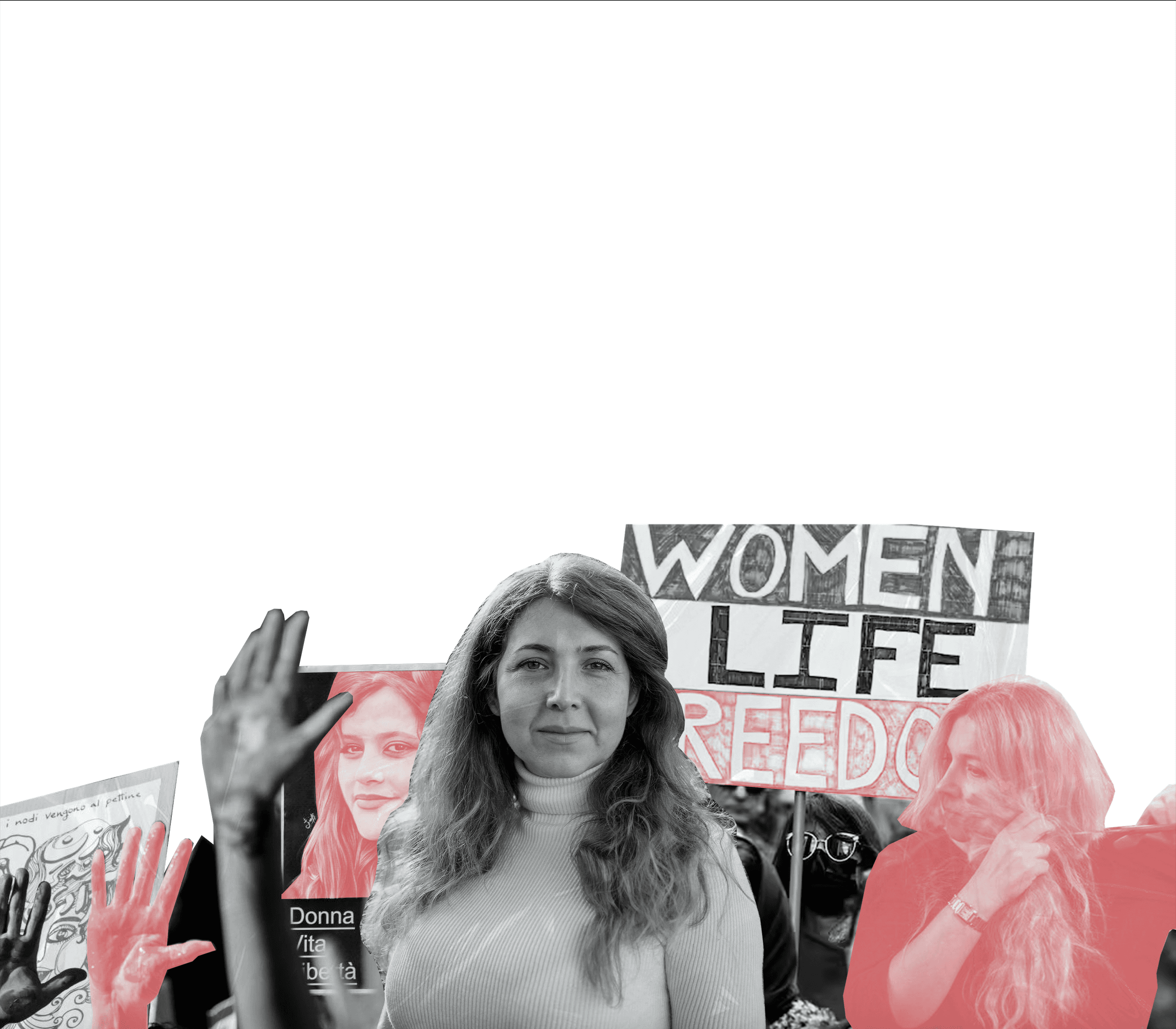
To overcome this, I used a collage technique in Photoshop; deconstructing, layering, and recontextualising the found imagery to create entirely new, original visual assets. This didn't just solve the asset shortage; the raw, fragmented nature of the collage style became a deliberate design language that mirrored the fractured reality of the movement itself.
Below are some Iterative sketches, collages & rough workings done in the beginning stages of the project:




/
Solution
(02)
Balancing Design Critique with Contributor Input
Lecturers & Design Peers: I constantly stripped back and rebuilt the visual hierarchy based on lecturer feedback. For Chapter 1, the feedback was focused on pacing. Ensuring the heavy, collage-style timeline didn't overwhelm the reader but instead guided their eyes through the historical shifts naturally. This pushed me to let the imagery do the heavy lifting, resulting in a layout so powerful that the narrative is fully understood without relying on text.
Iranian Contributors: I ran my copywriting and imagery past the Iranian women to ensure absolute authenticity. If a phrase felt off, or if a visual lacked the correct cultural nuance, I rewrote and edited it immediately based on their feedback.
Chapter 1: The Historical Timeline
The Strategy: To understand current-day Iran, users need to understand the (political) shifts that led here. I designed this chapter as a high-impact, collage-style visual timeline.
The Impact: Feedback on this chapter was definitive; the visuals are so raw and expressive that the narrative is fully understood without reading a single word of copy. The imagery is the language.
Chapter 2: Inspiring Iranian Women
The Strategy: Highlighting the women shaping the resistance movement, including high-profile human rights lawyers, authors & activists. My goal was to document their specific work, intellect, and structural impact on Iranian society.
Chapter 3: The Living Voices (Ethical Design & Primary Research)
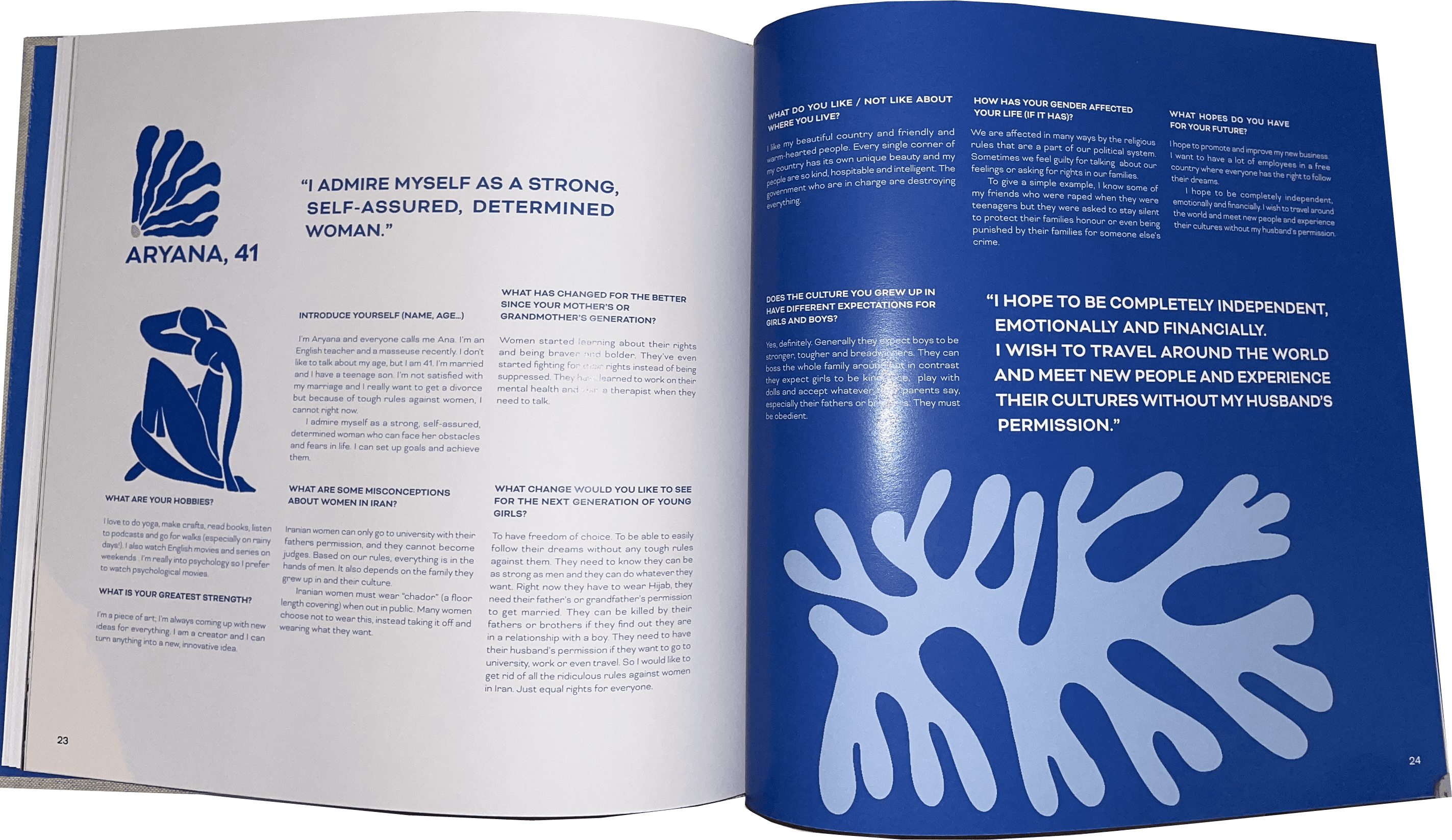
The Strategy: The anchor of the entire book. I conducted direct interviews with women currently living inside Iran.
The Constraint & Ethics: The stakes were incredibly high. Some participants had to drop out mid-interview due to the fear of surveillance. To protect them, I implemented strict data privacy guardrails: total pseudonymity, no identifying details, and zero photography.


/
Key Learnings & Project Conclusion
(03)
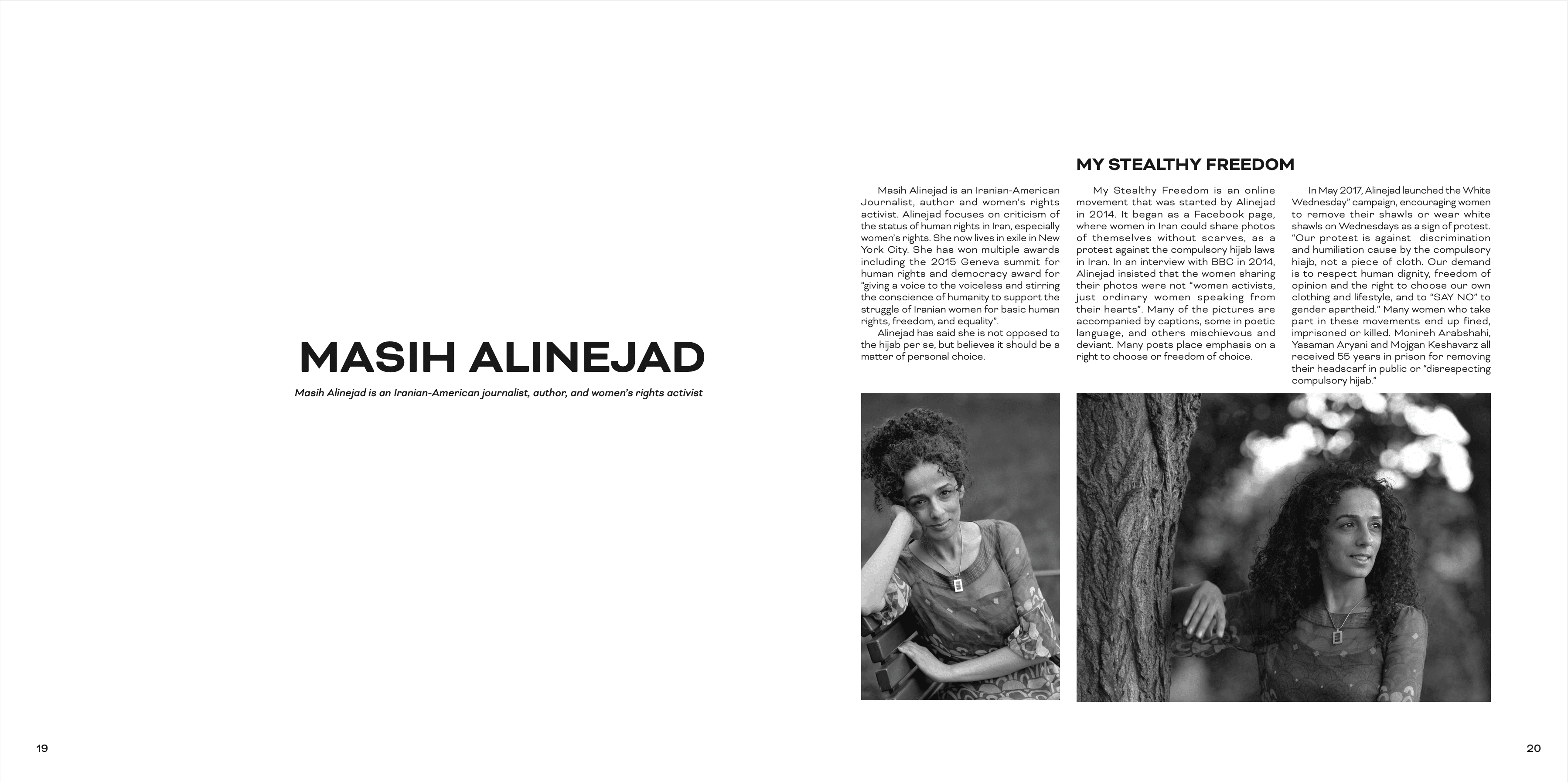
Final year Exhibition Unveiling
The Realities of Production & Fast-Paced Upskilling
Before this project, I had never designed a printed asset or used Adobe InDesign. I had to learn the software from scratch on a tight timeline, navigating print production, bleed lines, and paper stock to deliver a physical, three-chapter book for my final year show.
Ethical Research & High-Stakes Design Boundaries
This project taught me the true weight of ethical research. Handling primary insights from women living under surveillance forced me to prioritise participant safety above all else.
The Outcome
The final book was printed, bound, and displayed at my final year exhibition, the layout being shown below.
During the exhibition, I was approached by a secondary school teacher who highlighted the project's educational value, noting that the visual timeline and raw interviews should be printed and distributed as a resource to educate students. Seeing the work move from a software learning curve to an impactful educational tool validated the rigorous, research-first approach I took from day one.




Latest Projects.
A curated look at my work across UX, UI, and visual design.
Combining my roots in graphic design with digital problem-solving.

